

In Depth: North China Chokes as Air Pollution Rebounds in Early 2026
Listen to the full version
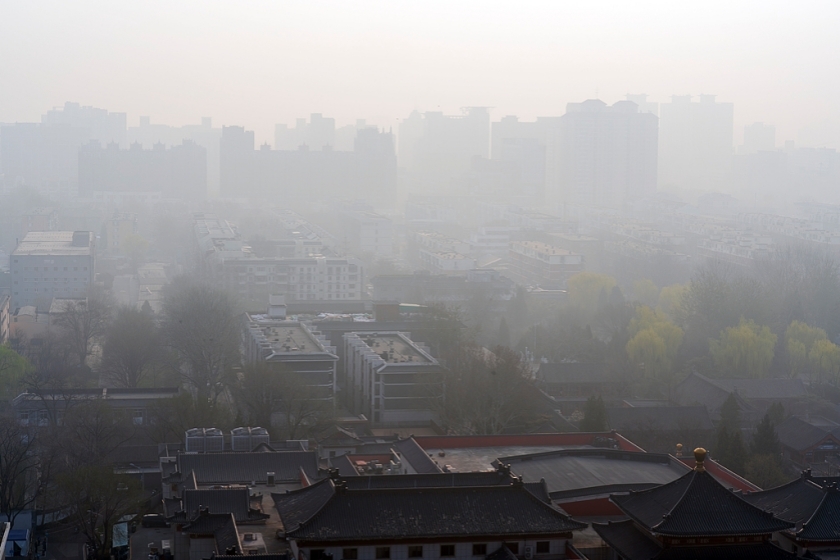
North China has experienced a sharp resurgence in air pollution in the opening months of 2026, driven by a combination of unfavorable weather patterns, industrial emissions and a widespread return to agricultural straw burning.
According to national air quality data released by the Ministry of Ecology and Environment and real-time monitoring statistics from non-profit environmental groups, PM2.5 concentrations in the Beijing-Tianjin-Hebei area and its surroundings have risen significantly year-over-year over the past two months. Beijing has seen a year-over-year increase of more than 30% in its monthly average concentration for two consecutive months.

Unlock exclusive discounts with a Caixin group subscription — ideal for teams and organizations.
Save an extra $50. Introductory offer for new readers. Subscribe now.
- RELATED
- DIGEST HUB
 Digest Hub
Back
Digest Hub
Back
- North China PM2.5 rose sharply in early 2026: Beijing-Tianjin-Hebei March avg 65.87 μg/m³ (+51.1% YoY), Beijing +36.6%; Northeast cities like Suihua +152.9%, Harbin doubled.
- Factors: unfavorable weather, industrial/coal emissions, Northeast straw burning causing spikes (Harbin 157 μg/m³ 7-day avg).
- New standards tighten annual PM2.5 to 25 μg/m³ (transitional 30 μg/m³); straw policy shifted from ban to restriction.
1. North China saw a sharp air pollution resurgence in early 2026 due to unfavorable weather, industrial emissions, and straw burning revival [para. 1]. PM2.5 levels in Beijing-Tianjin-Hebei (BTH) rose over 30% year-over-year (YoY) for two months [para. 2].
2. Northeast China, especially Heilongjiang, faced severe spikes; Harbin, Suihua, and Qitaihe PM2.5 surged over 100% YoY in March [para. 3].
3. IPE data showed March PM2.5 in BTH at 65.87 μg/m³, up 51.1% YoY; Beijing up 36.6% [para. 5][para. 6]. Northeast saw sharper rises: Suihua +152.9%, Harbin and Qitaihe doubled, Jiamusi/Jixi >90%, Liaoning cities >70% [para. 6][para. 7].
4. Shandong cities like Jinan, Zibo, Weifang, Dongying rose 70-90% YoY [para. 7][para. 8]. CREA report confirmed 18 provincial capitals up YoY, led by Harbin +112%, Shenyang +47%, Changchun +45% [para. 9].
5. February national data for “2+36” BTH cities: PM2.5 58.8 μg/m³ (+19.3% YoY), good air days 52.4% (-15 pts); Beijing 33 μg/m³ (+32%) [para. 10]. Hebei (e.g., Baoding 63.5), Henan (Xinxiang 64.5), Shandong (Dezhou 71.7) exceeded averages [para. 11].
6. Causes include weak cold air, southerly winds, inversions reducing dispersion in high-emission BTH region reliant on industry/coal/trucks [para. 13]. Expert Wang Yuesi: new five-year plan start leads to lax enforcement, “lying flat” in compliant cities [para. 14].
7. CREA: Jinan/Changchun rises from emissions; BTH from weather + emissions [para. 15]. Shandong pollution linked to oil refining surge (exports +12.7%, imports +43.3% Jan-Feb), small refineries [para. 16].
8. New standards from March 2026 tighten PM2.5 annual limit to 25 μg/m³ (Grade II), transitional 30 μg/m³ to 2030 [para. 17][para. 18]. Under 30 μg/m³, compliant cities drop from 271 to 205; under 25 to 140 (2025 data) [para. 19].
9. High-burden regions like BTH, Fenwei Plain face restructuring challenges; coastal/Yunnan could lead to 15 μg/m³ with zoned governance [para. 20].
10. Straw burning resurfaced in Northeast; Heilongjiang fires spread smog south to BTH via easterly winds [para. 21][para. 22]. Harbin March 23-29 avg 157 μg/m³ (peak >260); Suihua 120 μg/m³ (peak >175) [para. 22][para. 23].
11. Autumn 2025 Northeast fires: 3,589 spots (Heilongjiang 1,700), affected 90M people, peaks 2,179 μg/m³ [para. 24]. Historical issue: 860M tons annual straw, bans costly; 2025 policy shift to utilization + precise no-burn zones [para. 25][para. 26].
12. Professor Shen: straw use hard due to costs/tech; ag needs/tight schedules; farmer costs/conflicts [para. 27]. No-burn zones violated (e.g., near Harbin airport); CCTV probe showed lax enforcement [para. 28].
13. Global issue; shift to restrictions tests local governance per Wang [para. 29]. (Word count: 498)

- MOST POPULAR

 Sign in with Google
 Sign in with Facebook
 Sign in with 财新